Cottonwood, AZ · Garage Door Service
Cottonwood's 1960s-70s houses run original torsion hardware through severe summer heat. Here's what fails, why, and what a real fix costs in labor and parts.
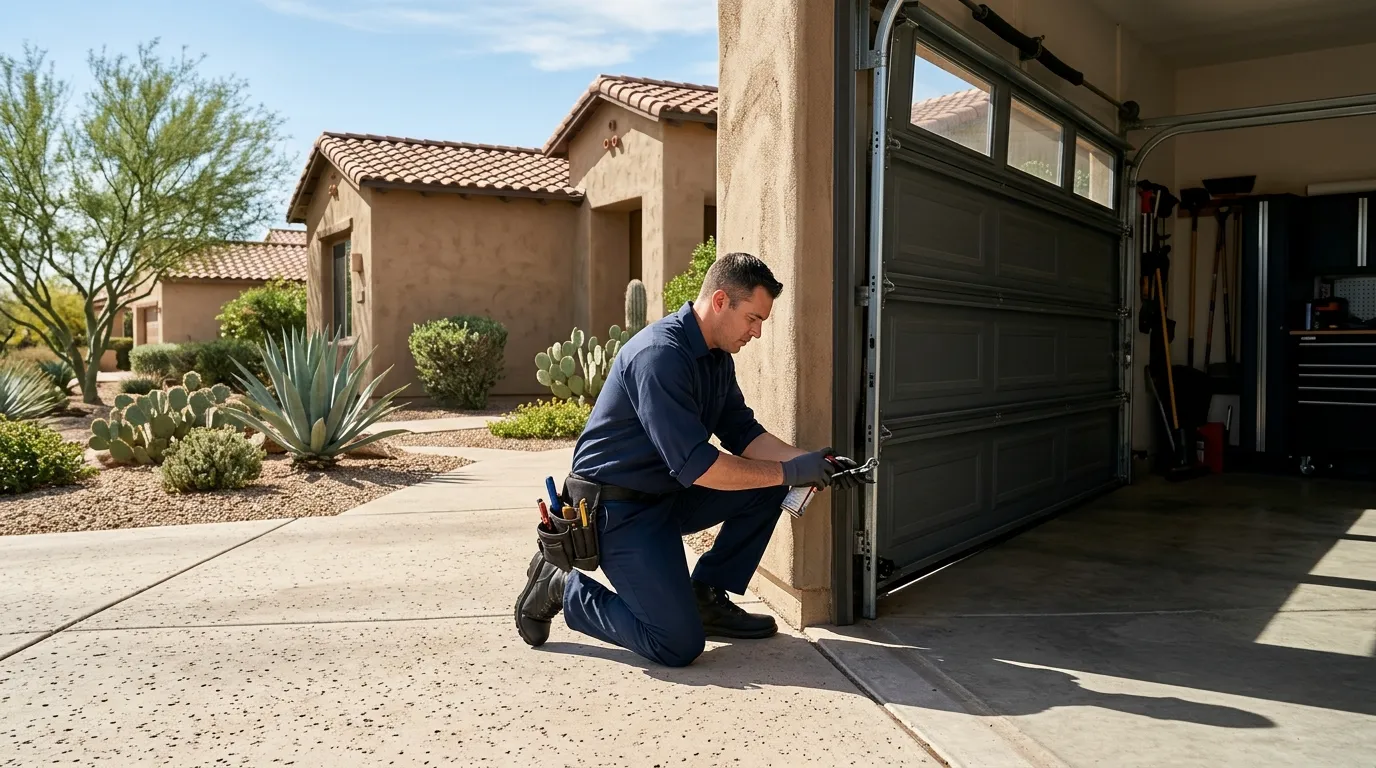
The door feels heavy the second you lift it by hand, or the opener strains and stalls halfway up. Sometimes there's a loud bang first, then the door won't move at all. On older doors you'll see a torsion spring that's split into two pieces on the shaft above the header, or a cable that's frayed and slipped off its drum. On newer setups the opener motor runs but the belt or chain just clicks without pulling the door.
A lot of this shows up first thing in the morning or late in the day, when the metal has had all night or all afternoon to sit at one temperature and then gets asked to move fast. If your door was fine yesterday and dead today, it's rarely one single event - it's the last cycle after months of the spring losing tension a little at a time.
Cottonwood's housing stock is mostly 1960s-70s construction, which means a large share of garages still run the torsion hardware and door panels that were standard for that build era. That hardware wasn't engineered for the duty cycles or the heat loads homes see now, and it shows up as sudden spring failure more than gradual wear.
Cottonwood sits in a severe heat climate band, and steel spring wire fatigues faster the hotter it runs. A torsion spring stores energy by twisting; every degree of extra heat softens the temper of that steel slightly, and repeated expansion and contraction across summer days accelerates metal fatigue in a way mild climates don't see. On a house built in the 1960s or 70s, that spring has likely already been swapped once or twice by a prior owner with generic hardware that isn't matched to the door's actual weight - which shortens the life of the replacement too.
Heat also cooks the lubricant on rollers and hinges, leaving tracks dry and gritty by mid-summer. A dry track adds resistance, the opener compensates by pulling harder, and that extra load transfers straight back into the spring and cable system. It's a chain: heat dries lubricant, dry hardware adds resistance, added resistance shortens spring life. None of that is unique to any one house - it's what the climate band does to that era of hardware across the board.
Don't touch a torsion spring under tension. It's wound tight enough to break a hand or worse, and there's no safe way to release or set one without the right bars and a clear idea of the door's actual weight - guessing wrong on spring size is how people get hurt on the second try, not the first. That part of the job isn't a DIY save, full stop.
What you can reasonably check yourself: pull the release cord and lift the door by hand. If it's smooth and stays roughly where you put it, the springs are probably fine and the problem is likely the opener or a track alignment issue. If it drops like a rock or you can barely lift it, that's spring failure and it needs a service call, not a fix-it video.
You can also clear the tracks of dust and re-lubricate rollers and hinges with a light garage-door lubricant - not household oil, which attracts more grit. That's cheap, low-risk maintenance that actually helps in this climate. Beyond that, leave the tensioned hardware alone.
A straightforward torsion spring replacement means matching spring size to the actual door weight, not just swapping in whatever's on the shelf - undersized springs are the reason a lot of Cottonwood garages are on their second or third spring failure already. On a door original to a 1960s or 70s build, that often means the drums, cable, and bearing plates get inspected at the same time, since hardware that old is usually due for more than just the spring.
We'll check the track alignment and roller condition too, since dry, heat-stiffened rollers put extra strain on whatever spring goes in next. If the opener has been straining against a bad spring for a while, it's worth testing the motor and gears separately - sometimes the spring failure is the symptom and a worn opener component is what caused it.
One honest limit: if the door panels themselves are warped or rusted through from decades of heat and sun, a spring and hardware fix will get it moving again but won't fix a door that's structurally at the end of its life. In that case we'll tell you plainly rather than keep patching it.
Cottonwood sits in a severe heat climate band, and heat fatigues spring steel faster than mild climates do. Combined with houses from the 1960s-70s era often running mismatched or already-replaced hardware, springs here tend to fail sooner and more suddenly than the average lifespan you'd read about generically.
No. A torsion spring holds enough stored tension to cause serious injury if it releases uncontrolled, and getting the size wrong for your door's actual weight makes it worse, not safer. This is one job worth paying for.
Probably not. If the door lifts smoothly and holds position when you pull the manual release, your springs are likely balanced correctly and the problem is more likely the opener motor, gears, or a track alignment issue rather than spring failure.
Call now or request a free quote - same-day service on most repairs, upfront written pricing.