Cottonwood, AZ · Garage Door Service
Cottonwood Garage Door Pros drives 22 miles to Chino Valley for garage door repair on the area's mostly late-1990s housing stock. No local depot, no same-day promises.
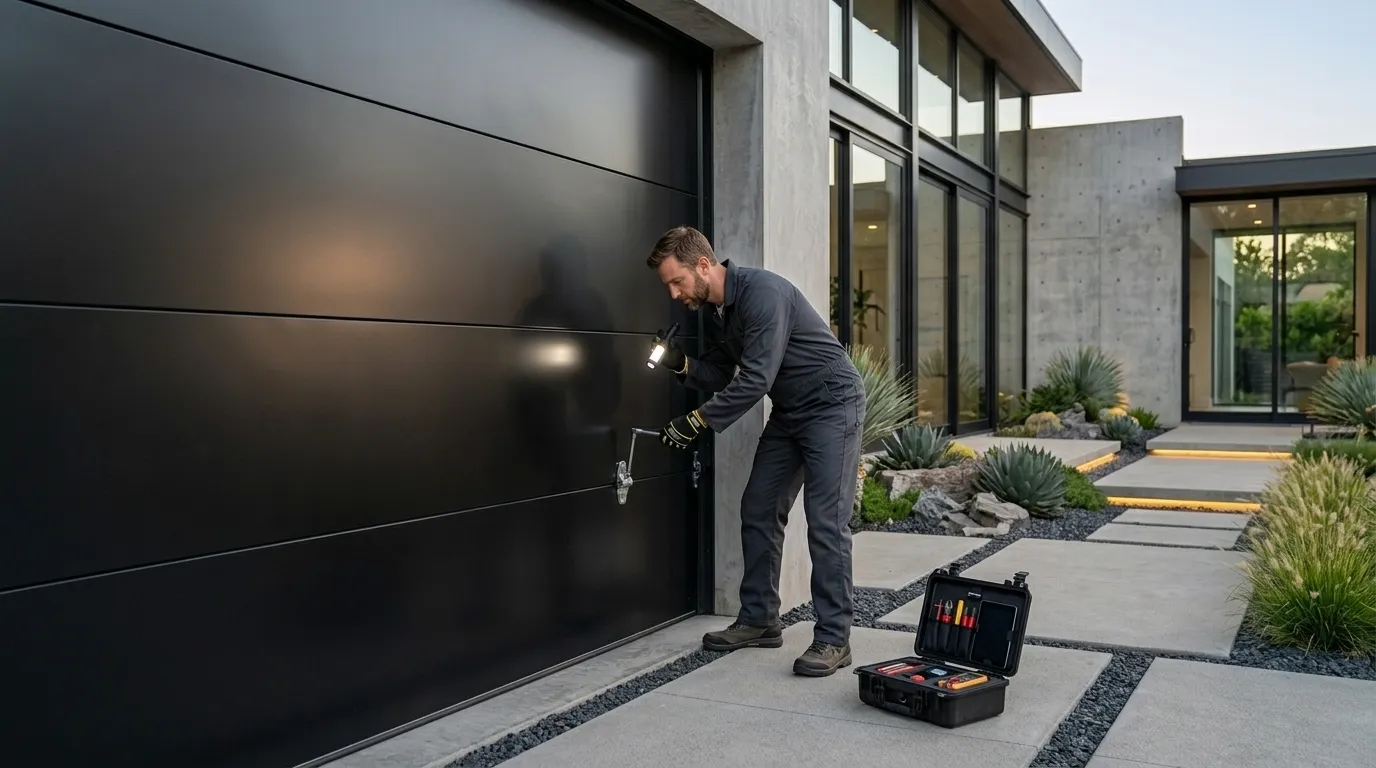
We don't keep a truck stationed in Chino Valley. Every job here means a 22-mile drive from Cottonwood, and we tell you that up front instead of pretending otherwise. We don't promise same-day service for routine calls - if your opener is just squeaking or a roller needs grease, that waits behind actual emergencies like a door stuck open or a spring that's let go. We don't replace a torsion spring when the fix is a $20 bearing plate, and we don't sell a full door replacement to someone whose 1999-built garage still has a sound frame and a repairable panel. If a part is unusual - an odd-width track bracket or a discontinued opener logic board - we tell you the lead time instead of guessing at an install date. Chino Valley's homes are newer than a lot of what we see closer to Cottonwood, so a good share of calls out here are opener electronics and weatherstripping, not structural spring failures, and we're not going to sell you spring work you don't need just because that's the bigger ticket. We also don't do gate or fence repair - doors and openers only.
The service area we cover overall runs mostly 1980s and 90s construction with a median build year of 1988, but Chino Valley itself skews newer - median year built here is 1999, more than a decade past the area-wide average. That decade matters. Houses built at the tail end of the 90s came with factory steel sectional doors, torsion springs mounted on standard center brackets, and openers with basic photo-eye safety sensors as a baseline rather than a retrofit. You don't get the mismatched hardware we sometimes find on older stock closer to Cottonwood, where a door's been swapped once or twice over 40 years and the track no longer matches the header. Chino Valley's 5,657 households are more likely to still have the original opener unit from construction, now pushing 25 years old - old enough that the logic board and photo-eye wiring are wearing out even though the door itself is fine. That's a different failure pattern than an older neighborhood, and it's why we ask the build year before we ask what's wrong.
The severe heat band this region sits in wears on openers before it wears on doors. In Chino Valley the calls we get most are aging opener units - original to a late-1990s build - where the circuit board has finally cooked past its life, or the photo-eye sensors have drifted out of alignment from years of thermal expansion in the bracket. Nylon rollers on doors from this era also go brittle under repeated heat cycling and start binding in the track, which owners usually describe as a door that 'shudders' partway through its travel rather than a door that won't move at all. Because the housing stock here runs newer, full spring replacements are somewhat less common than in older parts of our coverage area - springs from a 1999 install still have useful life left in most cases, and a lubrication and balance check often solves what looked like spring trouble. We do still see broken torsion springs, just less as the first suspect. With a median household income of $59,733 in Chino Valley, most owners we talk with want the repair that actually fixes the problem, not the most expensive one on the list.
A garage built in 1999 was built to a different sectional-door standard than one built in 1975. You're looking at a standard 7-foot steel door on torsion springs with center-mounted hardware, not the older extension-spring setups with side brackets that show up in earlier housing elsewhere in our service area. That's good news for parts - this hardware is common, and we're not hunting down a discontinued bracket. What it does mean is that at roughly 25 years old, a lot of Chino Valley doors are due for their first real hardware refresh: springs nearing the end of their cycle count, rollers past their service life, and openers that predate modern battery backup and rolling-code security. If your door was installed with the house in 1999, you're at the point where a full tune-up - springs, rollers, cables, opener check - costs less than waiting for one part to fail and force an emergency call. We'll tell you honestly if your setup still has years left or if it's at the edge.
No. We're based in Cottonwood and drive out about 22 miles for every Chino Valley job. There's no local depot, which means we schedule around the drive rather than offering instant same-day appointments for non-emergency work.
Chino Valley's median build year is 1999, so most doors here are approaching 25 years old. That's typically when torsion springs near the end of their cycle life and original openers start having sensor or circuit board trouble, even if the door still looks fine.
Heat cycling is hard on opener electronics and photo-eye sensors, and it happens faster than it wears down the actual door hardware. In this area's climate, opener failures on late-1990s units are more common than spring failures.
If the frame and track are sound, which is common on 1999-era construction here, repair usually makes more financial sense than replacement. We'll check balance, springs, and rollers before recommending a full swap.
Call now or request a free quote - same-day service on most repairs, upfront written pricing.